library(tidyverse) # for ggplot2 and tibble packages
library(tidyplots) # for plotting
library(terra) # for putting brain image on the plot
library(grid) # for putting brain image on the plot6 关于写作
关于写作的两个观点
最近留意到两个对于“写作/writing”的观点,反正笔者读进去了,因此分享出来,并不严谨的图示比较。
1. 观点1
Writing compels us to think — not in the chaotic, non-linear way our minds typically wander, but in a structured, intentional manner. (1)
写作迫使我们思考 - 不是以我们大脑通常混乱、非线性的方式,而是以一种结构化的、有目的的方式。(1)
2. 观点2

Clear lines of logical argument, precise definitions, often can only be composed in writing. Paper and pencil (or the word processor) are extensions of our brains. (2)
清晰的逻辑推理语句,精确的定义,通常只能由写作实现。纸和笔(或文字处理器)是我们人脑的扩展。(2)
3. 没有写作和有写作的人脑
3.1 下载人脑
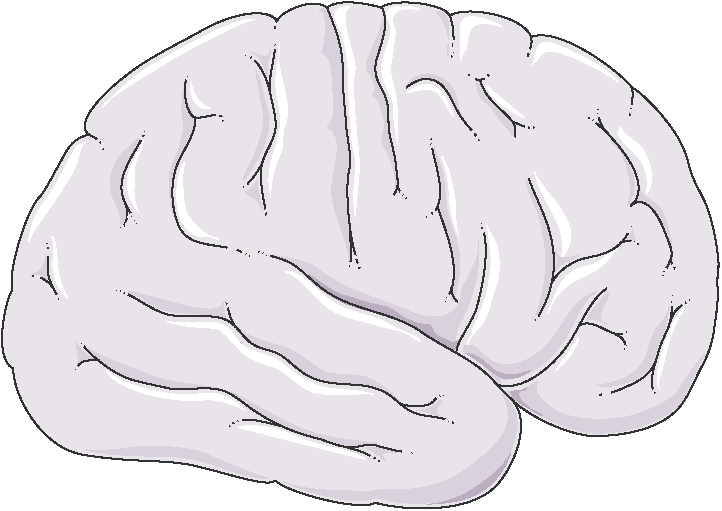
从https://bioicons.com/?query=brain通过点击复制“brain-1”。
在Adobe Illustrator中新建A4文档。
粘贴该brain到A4文档。
通过画板工具调整空白区域。
导出为png图片(150 ppi、消除锯齿:无、背景色:白色)。
3.2 无写作的人脑?(just for fun)
产生一个数据,用于重叠在人脑上。
set.seed(2025) # Set seed for graph reproducibility
x <- sample(10:90, 26) # Randomly sample 26 integers between 1 and 100

set.seed(2024) # Set seed for graph reproducibility
y <- sample(25:70, 26) # Randomly sample 26 integers between 1 and 100

works <- tibble::as_tibble( # Convert to a tibble
    data.frame( # Create a data frame
        x = x,
        y = y
    )
)
读取人脑图片。
brain <- terra::rast("images/brain.png") # read the imageWarning: [rast] unknown extentbrain <- terra::flip(brain, direction="vertical") # flip the image vertically
brain |> dim() # image dimension[1] 511 722 3brain <- as.array(brain)/255 # convert to array and normalize to [0, 1]; the original image is 8-bit RGB
brain <- grid::rasterGrob(brain) # convert to graphic object把数据线绘制/重叠在人脑上。
works |>
    tidyplot(x = x, y = y) |>
    add(ggplot2::annotation_custom(
        brain, xmin = 2, xmax = 100, ymin = 0, ymax = 100
    )) |> # add the brain
    add_data_points() |> # add the points
    add(ggplot2::geom_path()) |> # add the lines
    adjust_x_axis(limits = c(0, 100)) |>
    adjust_y_axis(limits = c(0, 100)) |>
    adjust_title("Brain without writing", fontsize = 12)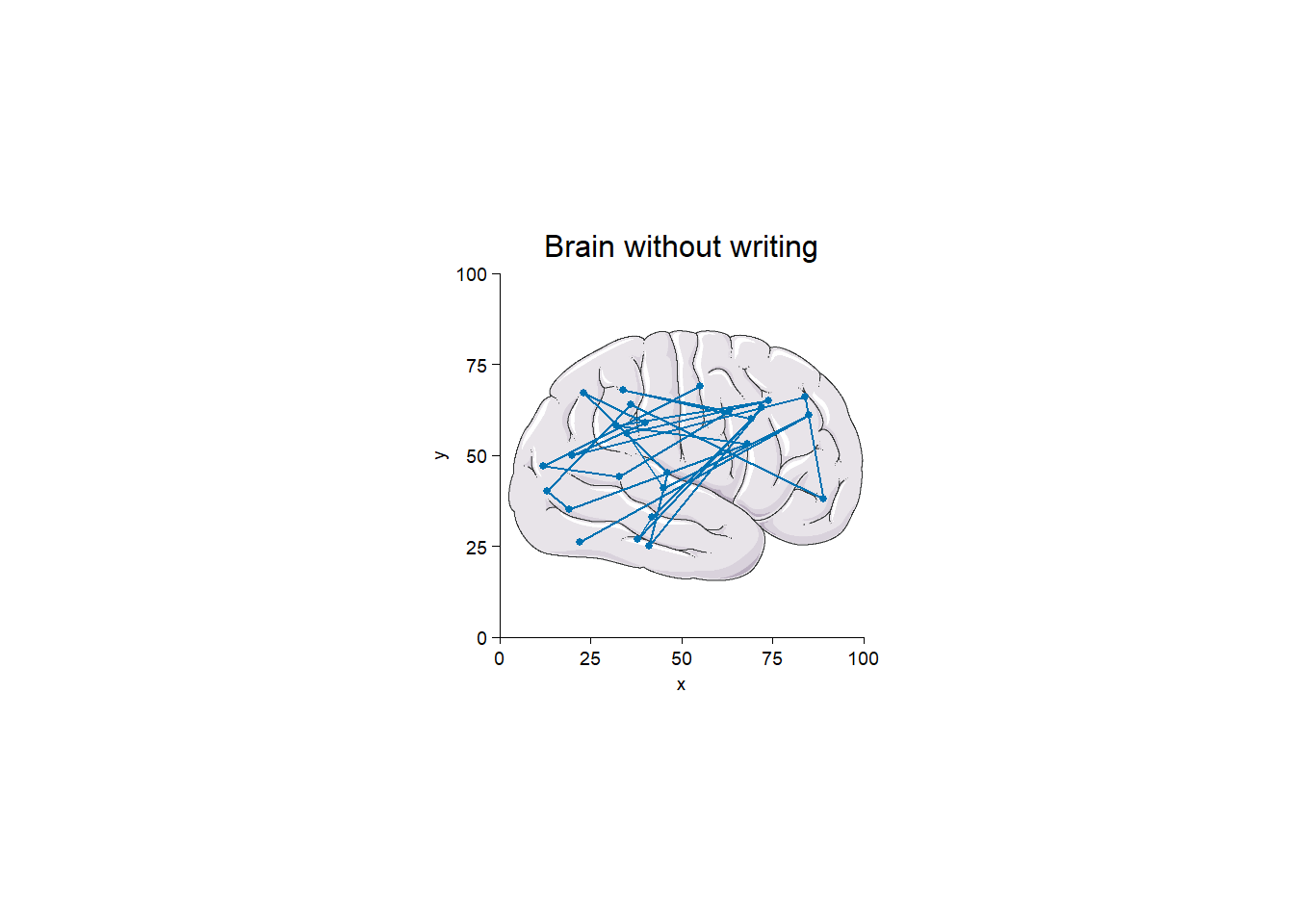
3.3 有写作的人脑?(just for fun)
works |>
    tidyplot(x = x, y = y) |>
    add(ggplot2::annotation_custom(
        brain, xmin = 2, xmax = 100, ymin = 0, ymax = 100
    )) |> # add the brain
    add_data_points() |> # add the points
    add(ggplot2::geom_step()) |> # add the lines
    adjust_x_axis(limits = c(0, 100)) |>
    adjust_y_axis(limits = c(0, 100)) |>
    adjust_title("Brain with writing", fontsize = 12)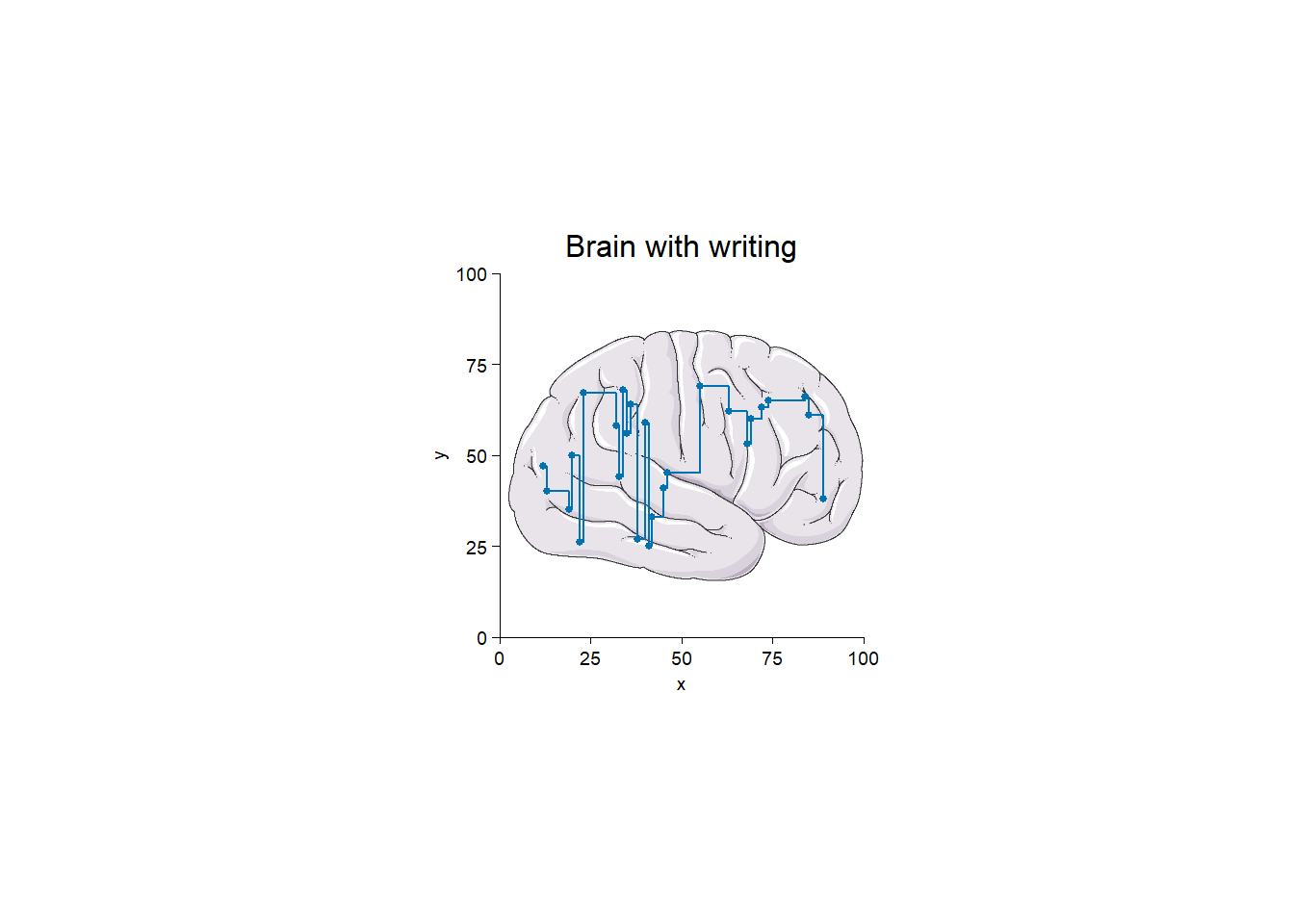
4. References
2.
W. Huber (2025-09-07). https://bsky.app/profile/wkhuber.bsky.social/post/3ly74ixycj22w.