60 拒付高版面费?
中科院拟拒付在高版面费杂志发表的文章
这几天时不时的从手机能够看到关于“据付高版面费”的相关新闻,也没细看。
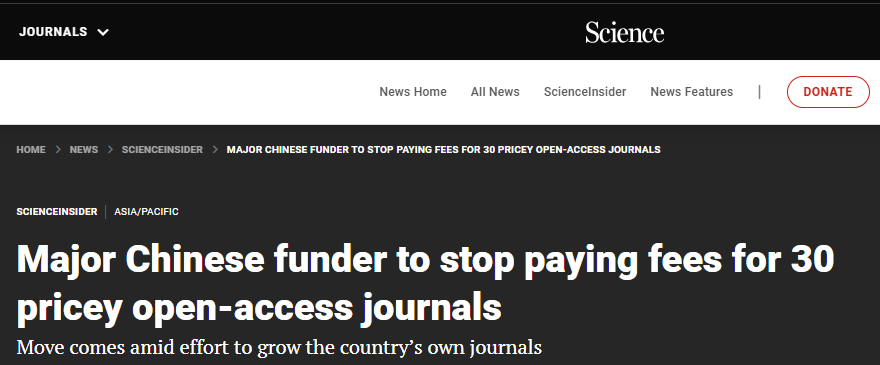
刚好偶尔看到Science杂志的一个scienceinsider (1),因此认真读了读,并提取些“干货”,并“有机”的调整结构,便于理解。
1. 中科院的“江湖”地位
the Chinese Academy of Sciences (CAS,中科院), the world’s largest research institution … employs more than 50,000 researchers across some 100 institutes.
2. 中科院的新版面费政策
CAS … plans to stop paying to publish their papers in dozens of international free-to-read journals it regards as too expensive … include Nature Communications, Cell Reports, and Science Advances … expected to take effect on 1 March.
the draft policy (of CAS) would prevent CAS scientists from using academy funds to pay article-processing charges (APCs) … for more than 30 journals ( > at least $5000 per paper).
The policy also bars them from using funds from other central government sources—presumably the Ministry of Science and Technology and the National Natural Science Foundation of China—to cover APCs in the proscribed journals.
Science Advances (SA) … charges an APC of $5450.
Nature Communications (NC), and … Cell Reports … charge APCs of $7350 and $5790, respectively.
Globally the average APC is about $2000.
3. NC和SA的来自中国的文章占比
In 2025, approximately 10% of papers in Nature Communications and Science Advances had a CAS-affiliated author, and about 40% of papers in each had an author at any institution in China.
4. 中科院的新版面费政策补充
They can also publish in “hybrid” open-access journals, such as Nature, that offer both paid open-access and paywalled options, but because that journal’s APC is $12,690, authors must publish behind the paywall, for which there is no charge.
5. 中国有多少英文的开放访问期刊且不收版面费
by 2023 the country (China) had about 178 English-language open-access journals, nearly half of which charged no APC.
6. 对其他中国机构的影响
Other institutions in China may follow CAS’s lead.
7. 中科院做的其他引领的政策
the institute (CAS) releases an Early Warning Journal List each year naming journals that bear signs of research misconduct, charge expensive APCs, or both.
the latest policy (of CAS) also prevents the outlays (支出) for an additional 120 journals that have been flagged for research-integrity problems.
8. 其他国家对于高版面费的态度和做法
For now, APC revenue flows mainly to international publishers, which many in China and elsewhere see as an unsustainable practice that allows some of the world’s largest publishers to reap excessive profits.
Germany’s national science funder, the German Research Foundation, for example, caps its reimbursements for APCs, an approach that the U.S. National Institutes of Health is considering adopting.